
Henry Nowak: How Anti-Racism Gave You Racism

Cast your mind back exactly 6 years. It is the summer of 2020 and Britain is undergoing what its commentariat breathlessly described as a “reckoning.” The murder of George Floyd by a Minneapolis police officer sent hundreds of thousands of British people into the streets. Statues were toppled. Corporations issued grovelling statements. Police officers — British police officers, in British cities, policing British people — took a knee before protesters. The message, repeated endlessly by politicians, journalists and institutions of every kind, was unambiguous: racism kills, and we will do whatever it takes to make sure it never happens again.
Six years later, an 18-year-old student named Henry Nowak was stabbed five times on a Southampton street. As he lay bleeding, he told the police officers who arrived at the scene exactly what had happened: he had been stabbed by Vickrum Digwa, who was standing nearby. Digwa, for his part, told the officers something else: that he had been the victim of a racist attack.
The officers believed Digwa, and handcuffed Nowak. As he lost consciousness, he could be heard on bodycam footage repeating the words “I can’t breathe” — the same four words that, six years earlier, had become the defining phrase of a political movement. They were stencilled on murals. Chanted at marches. Printed on t-shirts. They were spoken on the floor of the United States Congress and quoted in parliamentary debates in Westminster. When British police officers knelt in the streets of London, it was those words they were kneeling for.
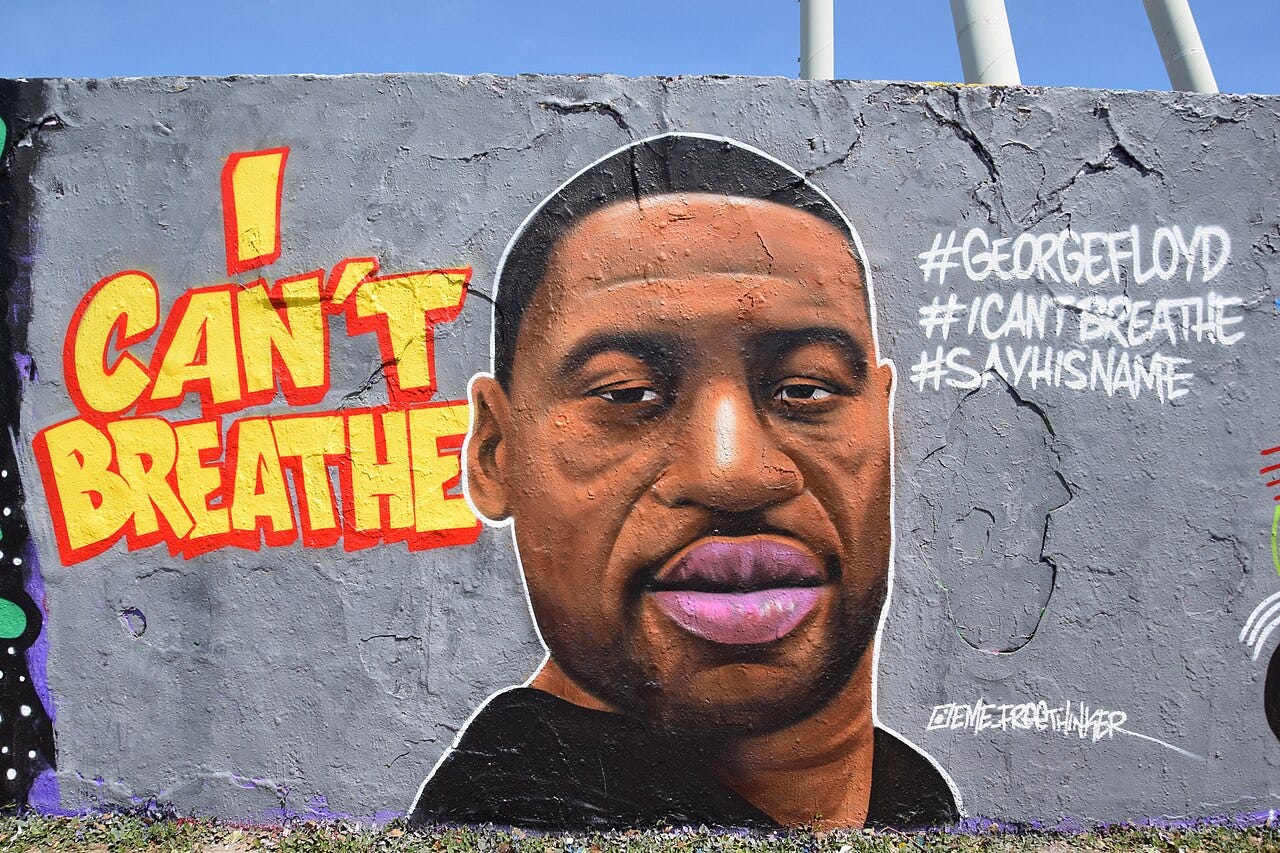
Henry Nowak’s last words, captured on bodycam footage released by Hampshire Police in the small hours of a Tuesday morning — the middle of the night, when the fewest people would see it — were the same. “I can’t breathe.” He said them while handcuffed on the pavement, bleeding from five stab wounds, to officers who had decided that the man who put those wounds in him was the real victim.
You will not see Henry’s words stencilled on a mural. No politician will quote them in the Commons. No corporation will change its logo. The same establishment that made four words immortal when spoken by a black man in Minneapolis has met the same four words, spoken by a white boy dying on a Southampton street, with what can only be described as a determined, institutional silence.
That silence is not neutral. It is a statement. It tells you exactly whose suffering the system has decided counts, and whose does not. And it was produced not by the old racism — not by skinheads and yobs — but by the people who spent six years telling you they had abolished it.
Digwa was convicted of murder last week and sentenced to life imprisonment. Hampshire Police issued a public apology, the IOPC launched an investigation, and a country that had spent the better part of a decade being lectured about the unique and unforgivable evil of racism was left to contemplate what its anti-racism had actually produced.
The answer, if you’re willing to look at it honestly, is this: a new form of racism. A bureaucratic racism. An actually institutionalised racism. A racism so thoroughly laundered through the language of progress and inclusion that the people enforcing it genuinely believe they are on the right side of history.
What else do you call a system in which a dying teenager’s word counts for less than his killer’s because of the colour of their skin?
To understand how we got here, you have to understand what the post-Floyd “reckoning” actually did to British institutions —especially the police. The response to Floyd’s death wasn’t merely emotional. It was ideological, and it was systematic. Forces across the country underwent mandatory diversity and anti-racism training. The principle drilled into officers, explicitly or implicitly, was that accusations of racism must be taken with the utmost seriousness — that the historic failure of institutions to believe minority victims of racism was the original sin, and it needed atoning for.
Racism is bad. Attempting to address it is good. The problem is what happens when you apply it without judgement in the real world: you train officers to weight an allegation of racism so heavily that it overrides the evidence in front of their eyes. You produce exactly the outcome we saw in Southampton — a man bleeding to death on the pavement, begging for help, being told by the officers who should be saving his life that they don’t think he’s been stabbed.
What is particularly striking about this case is the way it mirrors, almost exactly, the injustice that movement was supposedly designed to prevent. George Floyd died saying “I can’t breathe” while a police officer knelt on his neck. Henry Nowak died saying “I can’t breathe” while police officers knelt on his back and handcuffed him. The British establishment that wept for Floyd has been conspicuously quiet about Nowak. The politicians who marched through London’s streets in 2020 have not rushed to the cameras. The corporations that changed their logos and funded diversity initiatives have not issued statements.
This is not an accident, or even a surprise. It is the logical consequence of an ideology that does not actually oppose racism — it simply reassigns its acceptable targets.
I want to be precise here, because precision matters. I am not saying that the officers who attended the scene that night are bad people, or that they set out to let Henry Nowak die. I believe, in fact, the opposite: that they were following the spirit of their training, and of the culture that had been built around them, in good faith, over years. The problem is not the individuals. The problem is the system that produced them — a system that taught them, in effect, that an allegation of racism is a trump card that overrides normal investigative procedure, normal medical common sense, and normal human judgement.
That system was built with the best of intentions, by people who genuinely wanted to address real injustices. And it has produced a policing culture in which a killer can stab a teenager five times, claim to be the victim of racism, and watch the officers handcuff the person bleeding out on the street.
They will not acknowledge what they built. They will say that this was an isolated failure of individual officers, not a systemic problem. They will say that raising this case is itself a form of racism — an attempt to undermine legitimate anti-racism efforts by dwelling on an edge case. They will say, as they always say, that the real problem is that we haven’t gone far enough.
But that game is up. Anyone with the eyes to see and the ears to hear the truth knows what happened here. A young man is dead. His killer exploited an ideology to escape justice, if only briefly. And the institutions that were reformed in the name of anti-racism are now openly racist against white people.
Thanks KK. I am 56. This fear of being labelled racist has been around since I was a child at school. So 45 years at least. It has been the worst brush to be smeared with. And once smeared it’s all but impossible to lose the label Hence the enormous length that people will go to, such as ignoring the final breaths of a dying boy and two tier everything , to not be racist.
The police who were never racist against black men are now institutionally racist against white men.